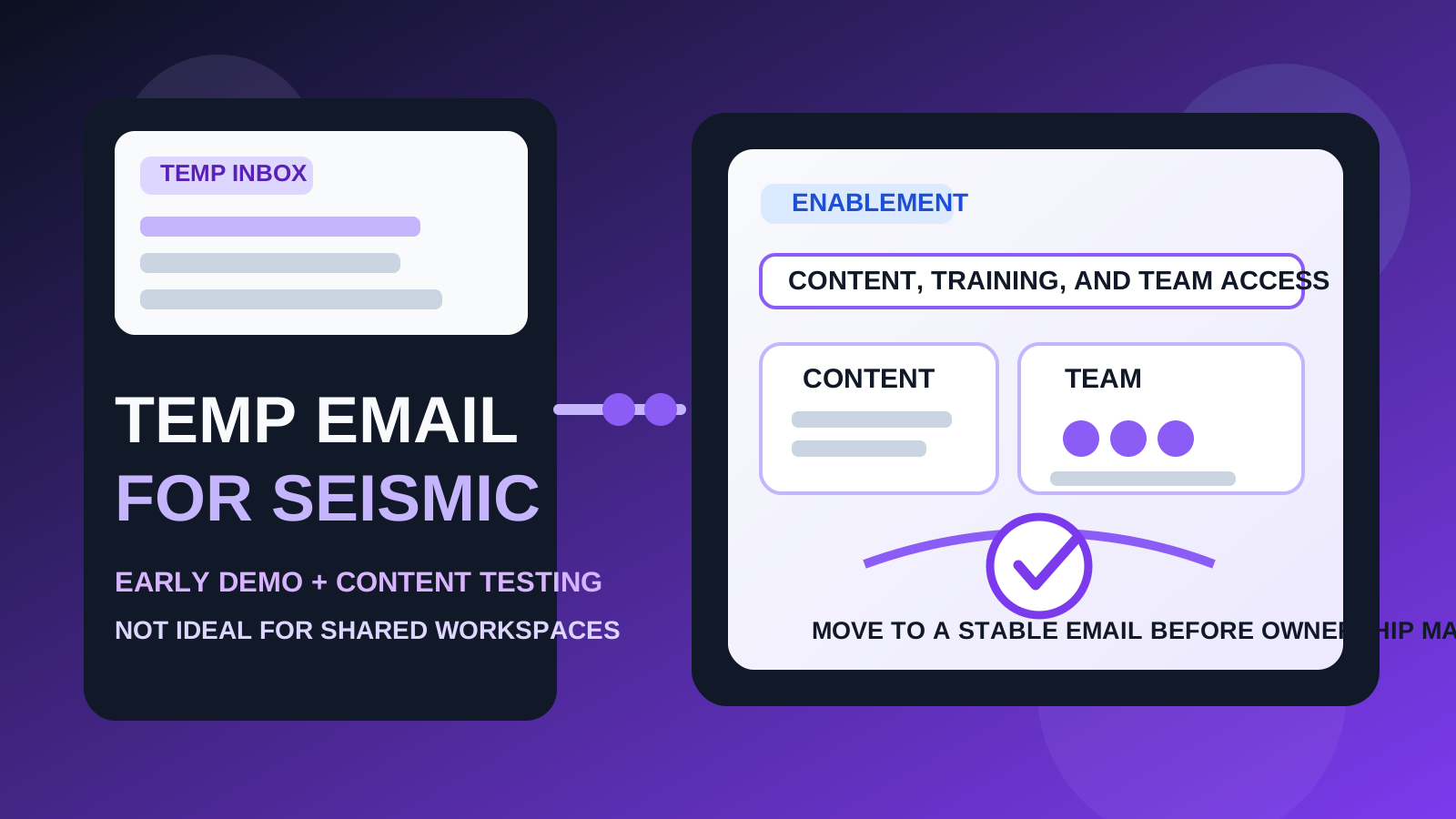
A temp email for Seismic can make sense for low-stakes signup, quick demo review, and early content testing.
It becomes a poor choice once the account is tied to shared enablement work, team invites, buyer-facing content, or long-term account recovery.
If you are evaluating Seismic, there is a good chance you are not browsing casually. You are probably checking whether the platform fits a real go-to-market workflow: sales content organization, onboarding, shared enablement resources, buyer-facing assets, or internal collaboration across teams. That makes the email choice at signup more important than it looks.
A disposable inbox can be genuinely useful during the first stage. It helps you verify the account, review the product tour, inspect the interface, and avoid turning your main inbox into a holding tank for follow-up messages before you have decided whether the platform belongs on your shortlist. But once the account starts holding useful content, training materials, workspace settings, or team access, the convenience flips. What felt tidy at the beginning can become the weak link later.
That is the practical answer: use temporary email for evaluation, not for ownership.
Why people consider a temp email for Seismic
Sales and enablement platforms often sit behind forms, verification emails, product tours, demo requests, and outbound follow-up. If you are comparing more than one tool, the inbox overhead can get old fast. A temporary address is appealing because it lets you:
- open the product quickly without exposing your primary work inbox right away
- separate one evaluation from another when comparing multiple vendors
- limit the amount of sales follow-up that lands in your long-term mailbox
- test whether the product feels relevant before sharing your real company address more broadly
That is a perfectly reasonable use case. Plenty of people do the same thing when comparing other sales enablement and demo tools such as Highspot, Showpad, or Consensus. The key is being honest about what stage you are in.
When a temp email for Seismic makes sense
1. You are doing a first-pass product evaluation
If the goal is simply to see the dashboard, understand the positioning, click through the onboarding flow, and decide whether the platform deserves deeper review, a temporary inbox is fine. You get the verification email, you open the account, and you keep that early exploration separate from your permanent inbox.
2. You are comparing several platforms in a short window
Evaluation gets messy when several vendors start sending welcome sequences, webinar invites, feature highlights, customer stories, and “book time with our team” nudges at once. A temp address can help you keep each trial compartmentalized so you can judge the product itself instead of drowning in follow-up.
3. You are testing with no expectation of keeping the account
This is the cleanest disposable-email scenario. If you already know the account is only for exploration, and you are not going to save important materials inside it, there is little downside. The account stays disposable because the purpose is disposable.
Where a disposable inbox becomes risky
Seismic is not the sort of product people always abandon after ten minutes. It can become a place where content, permissions, onboarding material, and team workflows start to matter. That is where a throwaway inbox becomes a liability.
1. Shared workspaces need continuity
Once the account is connected to a workspace, the email address attached to it is no longer just a signup detail. It is part of how access gets managed and how people identify the owner. A temporary inbox is a weak foundation for anything collaborative.
2. Team invites and role changes get harder
Many platform headaches do not appear at signup. They show up later when you invite a teammate, transfer responsibility, update permissions, or try to sort out who controls what. If the account began on a disposable address, those later steps can become unnecessarily awkward.
3. Useful content tends to accumulate quietly
One of the easiest mistakes is telling yourself you are “just testing,” then gradually storing something you actually care about: documents, links, content structures, onboarding notes, or feedback from teammates. By the time you realize the account matters, the email choice you made during a five-minute signup is already dragging behind it.
4. Account recovery is the obvious long-term problem
If you ever need to reset a password, confirm a security action, re-verify access, or prove that you still control the account, the email inbox matters again. A temporary mailbox feels convenient until the platform expects you to still have it weeks or months later.
A simple rule that avoids most problems
Use a temp email for Seismic only if you are evaluating the tool. Do not use one if you expect the account to support real work, shared access, or anything you may need to recover later.
That rule sounds basic, but it prevents most avoidable messes. Temporary inboxes are good for filtering, testing, and reducing early-stage inbox noise. Stable inboxes are better for ownership, collaboration, and account durability.
How to evaluate Seismic without creating cleanup work later
Start by defining the purpose
Before you sign up, ask one useful question: is this account for curiosity, or is it likely to become operational? If it is curiosity, a disposable address is reasonable. If there is a serious chance the platform could move into a real pilot or team conversation, starting with a permanent address may save time.
Save the emails that actually matter
During early evaluation, you usually only need a small number of messages:
- the original verification email
- the first onboarding or setup message
- any link that unlocks the account or explains next steps
- anything you may want to reference if you later recreate the account properly
Do not assume the temporary inbox will be available forever. If something matters, capture it while you are still in evaluation mode.
Test the parts that influence the buying decision
Instead of wandering through the platform, use the trial deliberately. For example, you might look at:
- how clearly the product explains its structure and workflow
- whether content organization feels intuitive or heavy
- how easy it is to imagine team adoption
- whether the onboarding feels practical or overly sales-driven
- what signs suggest the tool fits your real enablement process rather than just demo theater
A temporary inbox works best when it supports fast, focused evaluation. It is not there to support an indefinite half-committed account.
Switch before the account matters
If Seismic looks like a real contender, the best time to move to a stable address is early, before shared access and recovery questions appear. The longer you wait, the more likely it is that the “temporary” setup becomes annoying technical debt.
When a permanent email is the smarter choice from day one
Skip the disposable route and start with a stable inbox if any of these are true:
- you already expect teammates to join the evaluation
- you may store or review content that needs to remain accessible later
- you are running a real pilot instead of a quick product glance
- you want reliable recovery and admin control from the start
- the account may become tied to a formal buying or rollout process
In those cases, using a temp inbox usually saves a little annoyance up front while creating more friction later.
Common mistakes to avoid
- Treating a serious account like a throwaway: if the work is not disposable, the inbox should not be either.
- Waiting too long to switch: the safest migration point is before team invites, not after.
- Confusing inbox privacy with account safety: a cleaner inbox is useful, but it does not replace long-term account control.
- Forgetting about future verification needs: the important email is not always the first one.
- Using the same temporary inbox strategy for every tool: some signups are low-stakes, but some accounts clearly have more staying power.
A balanced workflow that works well
- Use a temporary inbox for first-pass evaluation and verification.
- Review the onboarding flow and core product structure quickly.
- Decide whether the platform is disposable to you or strategically relevant.
- If it is relevant, move to a stable inbox before shared access or saved work grows.
- Keep using your permanent address for anything connected to ownership, recovery, or team collaboration.
This is where Anonibox fits naturally. A temporary inbox is useful for the noisy early stage of software evaluation. It helps you protect your main inbox while you figure out whether a platform deserves more attention. It is just not a substitute for a stable address once the account starts carrying real weight.
Final takeaway
A temp email for Seismic is useful when you want to evaluate the product, verify the signup, and keep early-stage follow-up out of your main inbox.
It is the wrong long-term choice once the account is connected to shared workspaces, team access, buyer-facing content, or anything you may need to recover later. Use temporary email to keep trial chaos contained. Use a permanent email when the account becomes part of real enablement work.