A temp email for Sana Labs is useful for quick signup verification, early AI learning platform testing, and keeping trial messages out of your main inbox.
It becomes risky once the account starts to matter for admin ownership, learner access, shared workspaces, or account recovery.
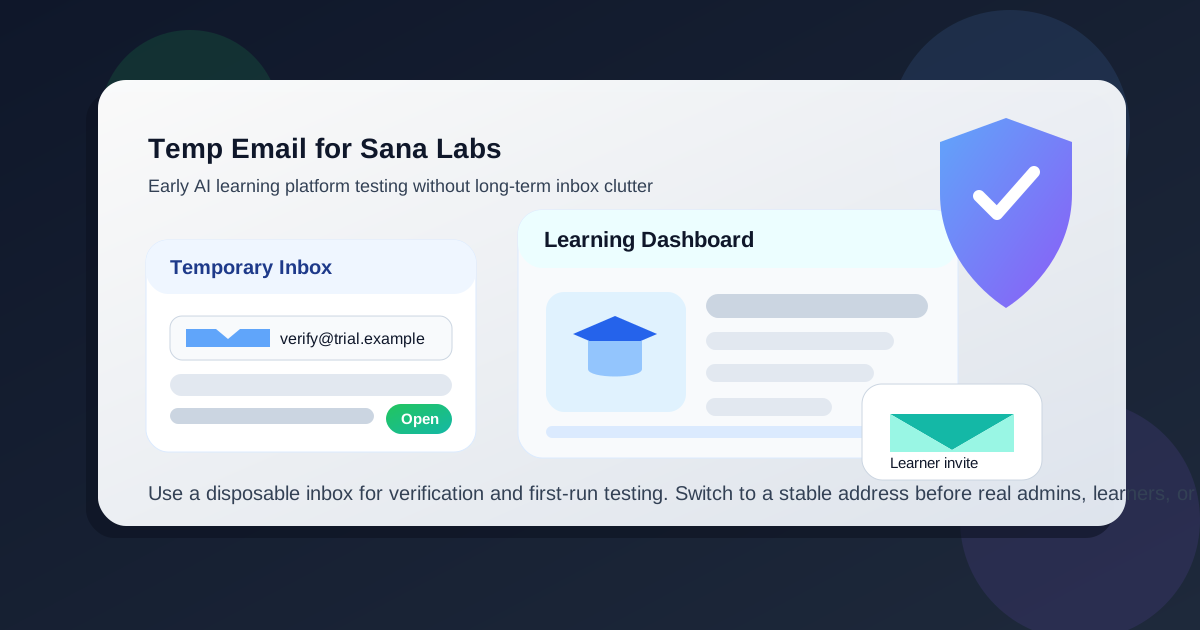
That is the real trade-off behind a temp email for Sana Labs. If you are only evaluating the platform, comparing it with other learning tools, or checking how the first-run flow works, a disposable inbox can be a sensible way to stay organized. If you are already building something real, though, the same convenience can turn into an access problem later.
Sana Labs sits in the kind of category where accounts often start as experiments and then become important faster than expected. A team may begin by previewing the workspace, testing AI-assisted learning paths, checking learner invites, or comparing setup friction against alternatives. A week later, that same trial can hold real admins, training content, pilot learners, or rollout decisions. That is why the email choice matters more than it first appears.
A tool like Anonibox fits the early stage well. You can receive the verification email, inspect the welcome flow, and keep vendor follow-up out of the inbox you use for everyday work. The key is understanding where the temporary stage ends and the operational stage begins.
Why people look for a temp email for Sana Labs
Most people are not looking for a burner inbox because they want to do anything shady. They usually want one of three practical things:
- Cleaner evaluation: they are comparing several platforms and do not want each one adding onboarding sequences to the same work inbox.
- Low-stakes testing: they want to verify signup, inspect the admin side, and judge the product before tying it to a permanent address.
- Better privacy: they are not ready to hand their long-term work email to every vendor they trial for thirty minutes.
That logic is reasonable. The problem is not using a temporary inbox at all. The problem is forgetting to switch after the account stops being temporary in practice.
When a temp email for Sana Labs makes sense
1. Early product evaluation
If your goal is simply to see how Sana Labs feels, a temporary inbox is often enough. You can create the account, click the verification link, enter the workspace, and answer the first important questions:
- Does the product feel intuitive?
- Does the onboarding make sense?
- Is the AI learning workflow actually useful for your use case?
- Does it deserve a deeper pilot compared with alternatives?
That is a good use case for a throwaway inbox because the email address mainly acts as a gatekeeper, not as a long-term identity anchor.
2. Comparing it with other learning platforms
Teams often test several tools side by side. You might review Sana Labs next to platforms focused on enablement, customer education, or LMS workflows such as WorkRamp, Skilljar, or EdApp. In that situation, a disposable inbox can keep the first round of messages separate and make the comparison less messy.
3. Testing learner invites and welcome messages
Email is part of the product experience in learning software. Before you recommend a platform, you may want to see how the first invitation reads, whether the setup messages are clear, and how the links behave. A temporary inbox is fine when you are inspecting the flow rather than launching a real program.
4. Sandbox or QA-style role checks
It is common to test different user roles before a broader rollout. You might want a short-lived account for a learner persona, a manager view, or a one-off invite check. Temporary inboxes are useful here because they keep those quick tests isolated and disposable on purpose.
Where a disposable inbox becomes risky
Sana Labs may begin as a simple trial, but it can easily become a workspace people depend on. That is where a burner address stops helping and starts creating risk.
1. Admin ownership should not depend on a throwaway address
If the account controls the real workspace, the email behind it matters. Admin ownership can affect permissions, workspace settings, integrations, and recovery steps. Losing access because the original inbox expired is a very avoidable problem.
2. Learner access gets harder to manage
Once real learners or team members enter the picture, the account is no longer just a test. Invitations, reminders, password resets, role changes, and support issues all become more serious. Those workflows are easier to manage when the platform is tied to an inbox that someone genuinely monitors long term.
3. Pilots have a habit of turning into production
This is one of the most common mistakes in software evaluation. A team says, “Let’s just test it quickly,” then slowly adds real content, real users, and real expectations. By the time anyone notices, the supposedly temporary account has become the default workspace. That is the worst moment to realize the original email was disposable.
4. Account recovery is the obvious weak point
The bigger danger often shows up later rather than immediately. Password resets, security checks, ownership confirmations, and verification emails all become painful if the address behind the account no longer exists or is no longer accessible.
A simple rule of thumb
Use a temp email for Sana Labs if you are evaluating the platform. Do not keep one attached if the account is becoming part of a real training, enablement, or learning operation.
That distinction keeps the decision clear. Disposable inboxes are good for filtering, testing, and early comparisons. Permanent inboxes are better for ownership, continuity, and recovery.
How to use a temp email for Sana Labs without making a mess
Start with a narrow goal
Before you sign up, decide what this account is for. Is it a quick test of the signup flow and dashboard? A comparison against other platforms? A short check of learner email behavior? If the goal is narrow and reversible, a temporary inbox is a reasonable tool.
Save the messages that matter
During the first pass, you usually only need a few things:
- the verification email
- the first onboarding instructions
- any links you may want to revisit while comparing vendors
- notes on how the initial learning flow felt
Do not assume you will remember everything later, and do not assume the inbox will remain available forever. Capture the useful bits while you still have them.
Test deliberately
The whole point of a disposable address is to reduce friction, not to create a half-built workspace that lingers in limbo. Use the trial to answer concrete questions:
- Is the admin experience clear?
- Do learner invites and first-run messages feel polished?
- Does the AI learning workflow actually help, or is it mostly marketing?
- Would your team realistically keep using this beyond the trial?
Fast, deliberate testing is where temporary inboxes provide the most value.
Switch early if the account starts becoming important
The safest moment to move to a permanent address is before anything critical depends on the account. Do it before you invite real teammates, build a serious pilot, upload important content, or position the workspace as something the company may keep.
When a permanent email is the better choice from day one
Skip the burner inbox and start with a stable address if any of these are already true:
- you expect the account to become the real workspace owner
- you plan to invite teammates or learners immediately
- you are evaluating with a high chance of procurement or rollout
- you need reliable account recovery and security continuity
- you are creating content or structures you would not want to lose
In those cases, the short-term convenience of a temp inbox is usually smaller than the future cleanup it can create.
Realistic examples
Good use case
A learning lead wants to compare three AI or LMS-style platforms in one afternoon. They need to verify accounts, inspect onboarding, review the interface, and decide which tool deserves a proper internal demo. A temp inbox is perfectly reasonable there because the evaluation is short, reversible, and not tied to real ownership yet.
Bad use case
A team creates a Sana Labs account with a disposable inbox, builds sample content, invites a few colleagues, and then keeps using the same workspace for a live pilot. That is when the temporary email becomes a liability. The account may now matter to multiple people, but its recovery path still depends on a throwaway address.
What about privacy and spam?
This is where disposable email really earns its keep. Software trials can lead to weeks or months of sales follow-up, reminders, event invites, and nurture sequences. If you are still in discovery mode, there is nothing wrong with keeping that noise out of your main mailbox. It is a practical privacy and inbox-management decision.
Just remember that privacy protection and durable ownership are different goals. A temporary inbox is good at the first one. It is bad at the second one once the account has operational value.
Final answer
A temp email for Sana Labs is a smart option for early testing, comparison shopping, and first-run verification. It helps you protect your main inbox while you decide whether the platform is worth more time.
But once the workspace starts to matter for real admins, real learners, shared access, or future recovery, switch to a stable monitored address. That is the safest balance: use temporary email for evaluation, then move to permanent ownership before the account becomes important.